Ioannis Mandralis
PhD | Center for Autonomous Systems and Technologies | Caltech
About Me
I received my PhD from the Center for Autonomous Systems and Technologies (CAST) at Caltech, where I was fortunate to work with Professor Morteza Gharib and Professor Richard M. Murray. My doctoral research explored new approaches for enabling autonomy in multimodal robotic systems, with a focus on developing methods that bridge learning, control, and physical hardware. My PhD thesis was recognized with the Hans G. Hornung Award for the best Ph.D. defense presentation by a student advised by aerospace faculty, as well as the Rolf D. Buehler Memorial Award for exemplary academic performance.
I am currently a Postdoctoral Researcher at EPFL/Empa, working with Professor Mirko Kovac on multimodal robotics. My research broadly focuses on enabling autonomy in robotic systems by combining ideas from learning and control with a strong emphasis on real-world robotic platforms. In particular, I am interested in developing aerial robots with novel morphologies and exploring multimodal behaviors that allow robots to move and interact across terrestrial, aerial, and aquatic environments. I am a recipient of the Onassis Foundation Scholarship.
Before joining Caltech, I earned my Master’s degree in Mechanical Engineering and Robotics from ETH Zurich in 2020 and my Bachelor’s degree in Mechanical Engineering from EPFL in 2018. During my time at ETH Zurich, I worked with Professor Petros Koumoutsakos on deep reinforcement learning approaches for the control of soft swimming bodies.
I also spent six months as a Robotics Engineer at ANYbotics, an ETH Zurich spin-off in Zurich, where I worked on the autonomy stack of then quadruped robot ANYmal.
Research
Multi-Modal Robotics
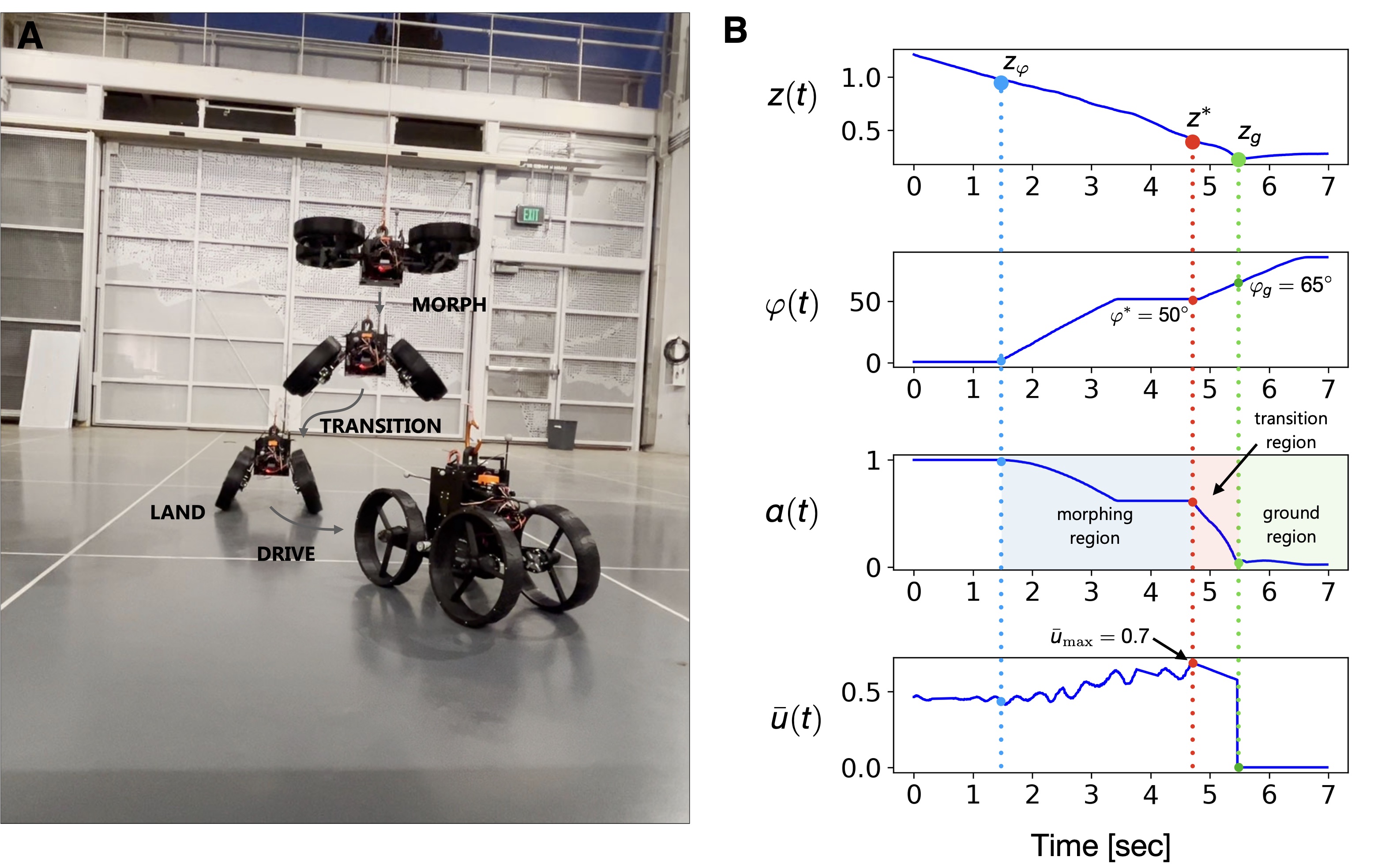
Design and testing multi-modal robots, such as the Aerially Transforming Morphobot (ATMO), capable of dynamically switching between aerial and terrestrial locomotion modes.
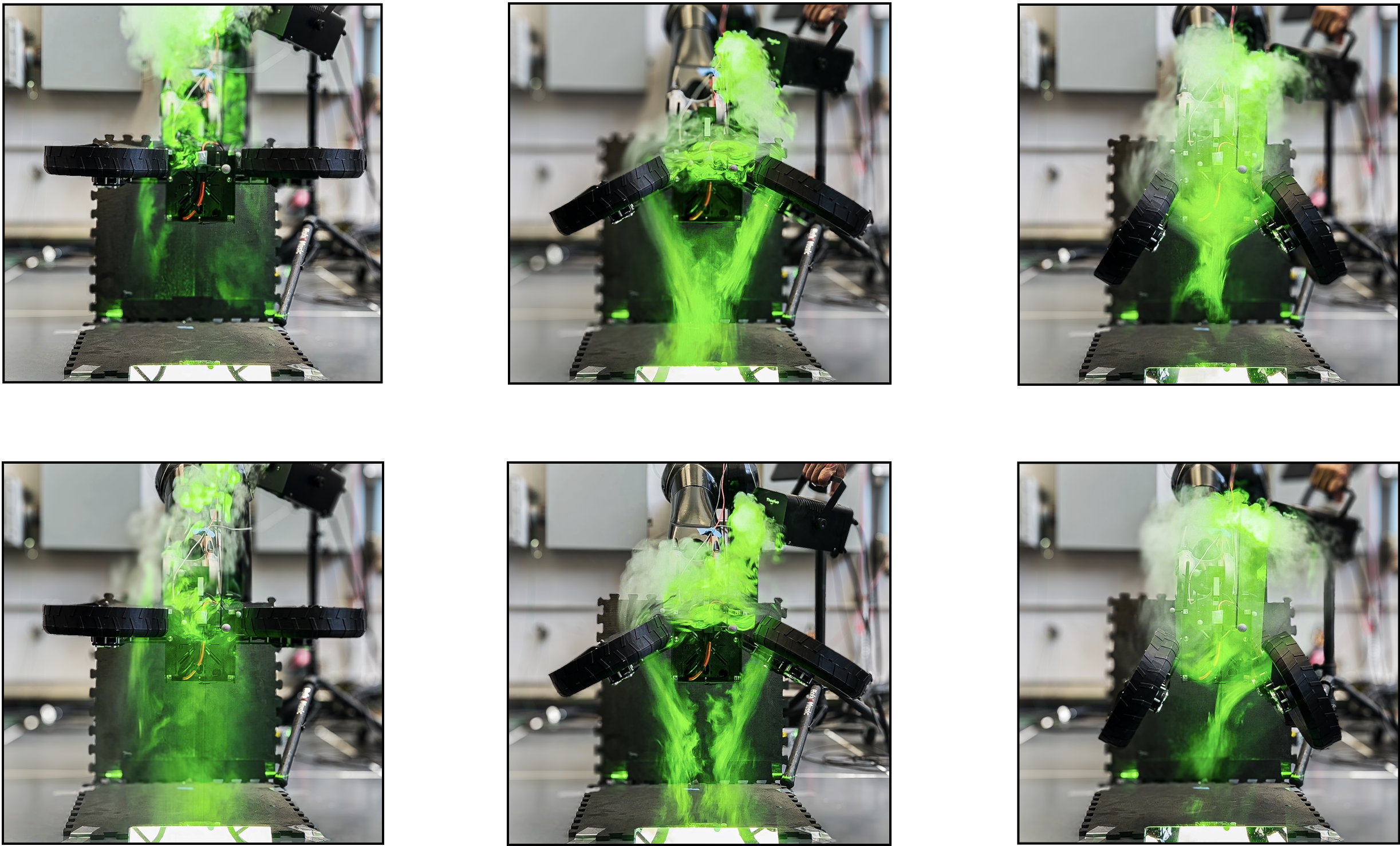
Mid-air robotic transformation leads to unexpected aerodynamic effects which I analyze using aerodynamic experimental testing and rigorous theory.
The findings are used to inform the control algorithms for smooth transition behaviours.
Relevant Publications
-
Wake Vectoring For Efficient Morphing Flight
I. Mandralis, S. Schumacher, M. Gharib.
Under Review, 2026.
-
Quadrotor Morpho-Transition: Learning vs Model-Based Control Strategies
I. Mandralis, R. M. Murray, M. Gharib.
Published IEEE/RSJ International Conference on Intelligent Robots and Systems (IROS), 2025.
-
ATMO: an aerially transforming morphobot for dynamic ground-aerial transition
I. Mandralis, R. Nemovi, A. Ramezani, R. M. Murray, M. Gharib.
Published in Nature Communications Engineering, 2025.
-
Self-supervised cost of transport estimation for multimodal path planning
V. Gherold, I. Mandralis, E. Sihite, A. Salagame, A. Ramezani, M. Gharib.
Published in IEEE Robotics and Automation Letters, 2025.
-
Minimum time trajectory generation for bounding flight: Combining posture control and thrust vectoring
I. Mandralis, E. Sihite, A. Ramezani, M. Gharib.
Published in European Control Conference (ECC), 2023.
-
Demonstrating autonomous 3d path planning on a novel scalable ugv-uav morphing robot
E. Sihite, F. Slezak, I. Mandralis, A. Salagame, M. Ramezani, A. Kalantari, A. Ramezani, M. Gharib.
Published in IEEE/RSJ International Conference on Intelligent Robots and Systems (IROS), 2023.
Soft Robotics
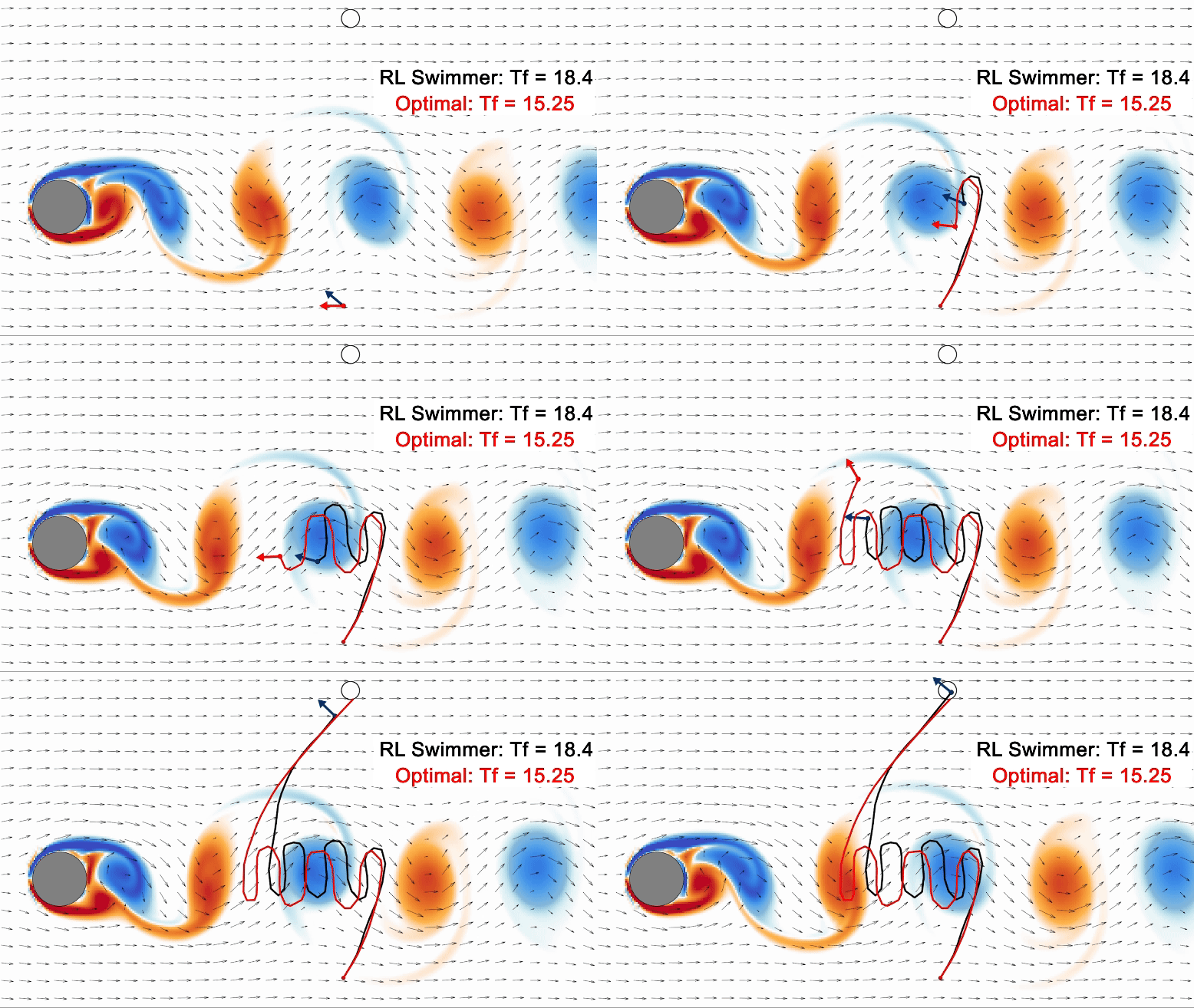
For soft robots operating in fluid media the time variation of the body shape required to produce favorable behaviours are very complex to uncover using traditional control methods. I am working on using AI based methods for learning behaviours of such systems. An example is producing the maximum possible acceleration with a limited energy expenditure in swimming fish robots.

Soft aerial robotics for energetically efficient multi-modal flight. Currently developing a new concept for a flexible surface controlled by thrusters. Such a surface can improve agility and crash tolerance, while reducing energetic cost of locomotion. Have also worked on sensing methods using ultrasound for shape reconstruction of thin wires under large deformations.
Relevant Publications
-
Ultrasound Shape Sensing
A. Rosakis, I. Mandralis, M. Gharib.
US Patent Application, 2025.
-
Learning swimming escape patterns for larval fish under energy constraints
I. Mandralis, P. Weber, G. Novati, P. Koumoutsakos.
Published in Physical Review Fluids, 2021.
AI for Control
I am actively investigating how AI can be used for control in situations when the system dynamics are too complex to model and control with standard approaches, and also for robotic explorers with partial information.
Relevant Publications
-
Data Driven Modeling for On-Demand Flow Prescription in Fan-Array Wind Tunnels
A. A. Stefan-Zavala, I. Scherl, I. Mandralis, S. L. Brunton, M. Gharib.
Published in Flow, 2025.
-
Learning efficient navigation in vortical flow fields
P. Gunnarson, I. Mandralis, G. Novati, P. Koumoutsakos, J. O. Dabiri.
Published in Nature Communications, 2021.
-
Quadrotor Morpho-Transition: Learning vs Model-Based Control Strategies
I. Mandralis, R. M. Murray, M. Gharib.
Published IEEE/RSJ International Conference on Intelligent Robots and Systems (IROS), 2025.
-
Learning swimming escape patterns for larval fish under energy constraints
I. Mandralis, P. Weber, G. Novati, P. Koumoutsakos.
Published in Physical Review Fluids, 2021.
Talks
- Invited Talks at University of Wisconsin–Madison, Vanderbilt, and McGill University. February, 2026.
- Quadrotor Morpho-Transition: Learning vs Model-Based Control Strategies. Oral Presentation, IROS, Hangzhou, China, 2025.
- Invited Talk at the HiPeR Lab, University of California Berkeley April, 2025. Thank you Mark Mueller for hosting me!
- Thrust recapture for morphing aerial vehicles with out of plane thrusters. APS Division of Fluid Dynamics, 2023.
- Investigation of surface pressure fluctuations in airfoils subject to transverse gust: towards gust mitigation. APS Division of Fluid Dynamics, 2021.
Teaching
-
Optimal Control and Estimation (CDS112/Ae103b)
Caltech, Winter 2023. Professor: Richard M. Murray. -
Aerospace Control Systems (Ae103a)
Caltech, Fall 2023. Professor: Amir Rahmani (JPL). -
Control Systems II
ETH Zürich, Spring 2020. Professor: Roy Smith. -
Thermodynamics
EPFL, Spring 2017. Professor: Veronique Michaud. -
Analytical Mechanics
EPFL, Spring 2016. Professor: Philippe Mullhaupt.
Media Coverage
Caltech covered our work on the Aerially Transforming Morphobot, published in Nature Communications Engineering, on its website (Caltech article) and on its YouTube channel:
We built a second version of ATMO (Aerially Transforming Morphobot) for our collaborators at the Technology Innovation Institute (Abu Dhabi). We demonstrated a package delivery mission in an outdoor environment. The result was covered by the TII media team. We also presented ATMO at IROS 2024 (Abu Dhabi). The robot was covered by the national television channel Sky News Arabia. See media coverage.
Our work on learning efficient navigation in vortical flow fields, published in Nature Communications, was covered by the media team at Caltech, and multiple other outlets. Engineers Teach AI to Navigate Ocean with Minimal Energy.