Research / Featured research

Ground-Aerial Morphing Robotics

Robots that fly and drive with the same body. We design morphobots that reuse one set of actuators across locomotion modes and transform in mid-air to land on their wheels, and we study the aerodynamics that make such transitions possible: ground effect close to touchdown, and rotor wake that can be redirected rather than lost.

In the media: Caltech video · Sky News Arabia · TII delivery demo

Nature Communications Engineering · 2025

ATMO: an aerially transforming morphobot for dynamic ground-aerial transition

I. Mandralis, R. Nemovi, A. Ramezani, R. M. Murray, M. Gharib

ATMO lands by changing shape in mid-air. Its four thrusters tilt during descent to become wheels, so the robot touches down already configured to drive. Close to the ground the air works in its favour: ground effect lets ATMO land at body postures beyond its thrusters' saturation limit.
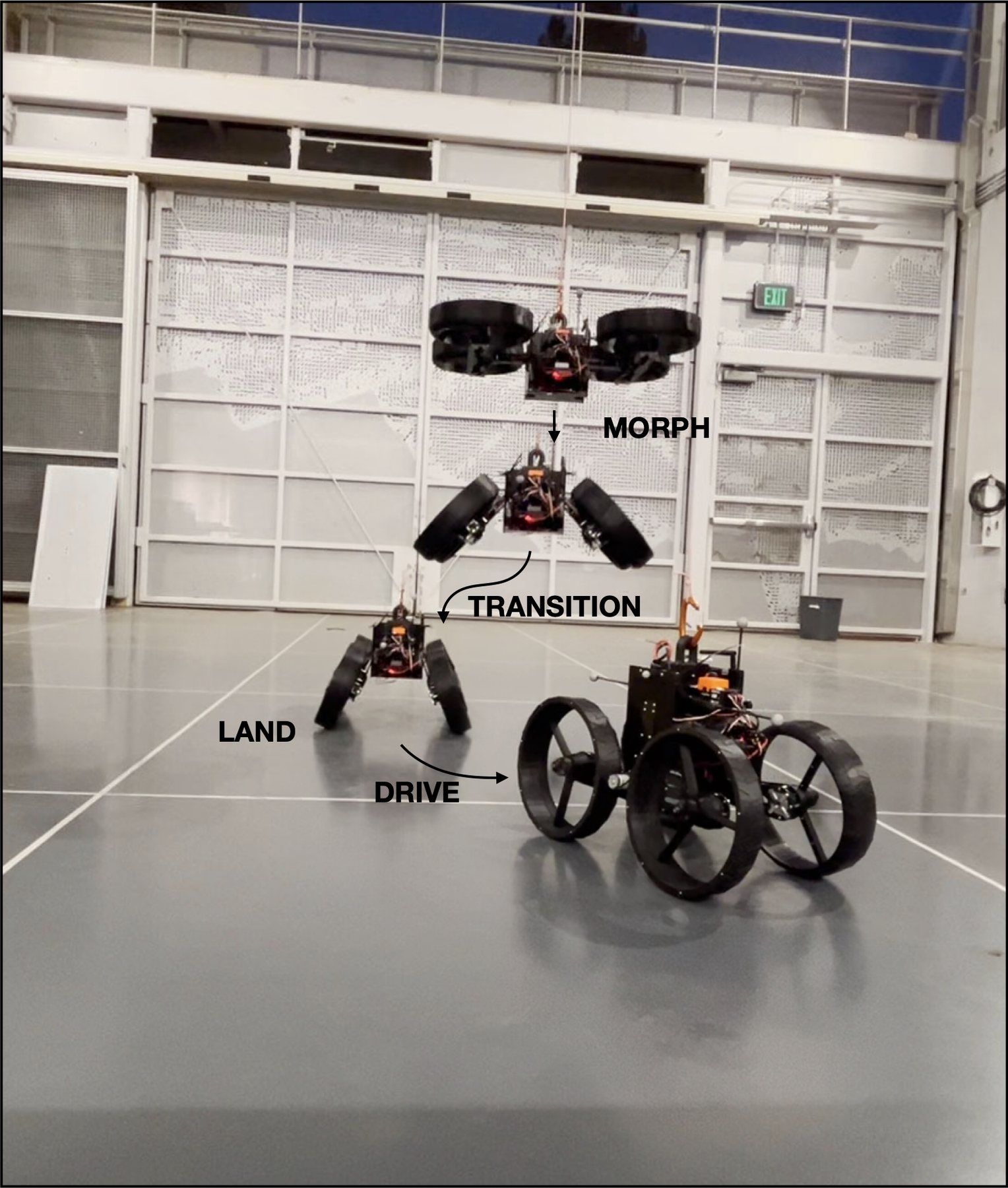
Composite of ATMO morphing in flight, transitioning, landing on its wheels and driving away
Morph, transition, land, drive. One continuous dynamic wheel landing, shown as a composite. ATMO folds its rotors inward as it descends and meets the floor as a ground vehicle; a model-predictive controller that adapts to body shape and ground proximity keeps it stable throughout.
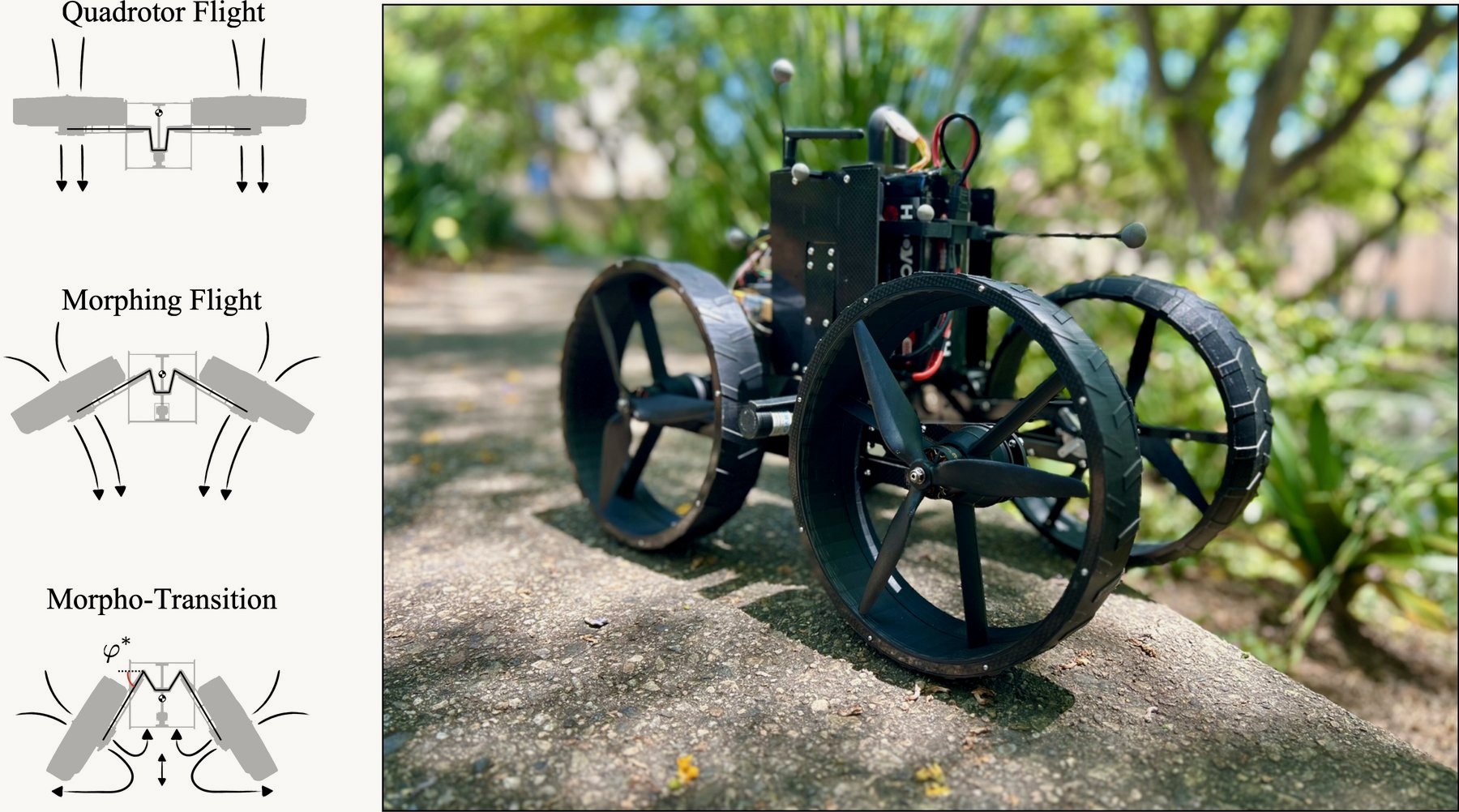
Diagrams of quadrotor flight, morphing flight and morpho-transition beside a photo of ATMO outdoors in drive mode
One set of actuators, two ways to move. The ducted rotors that lift ATMO are also its wheels. As the body folds from quadrotor flight through morphing flight to morpho-transition, the rotor wake turns outward and thrust is traded for a shape the robot can drive in.

Under Review · 2025

Wake vectoring for efficient morphing flight

I. Mandralis, S. Schumacher, M. Gharib

Tilting a rotor to change shape costs lift. Deflectors built into ATMO's frame intercept the rotor wake and turn it back toward the ground, recovering up to 40% of vertical thrust in configurations that would otherwise produce almost none, with no added motors or electronics.
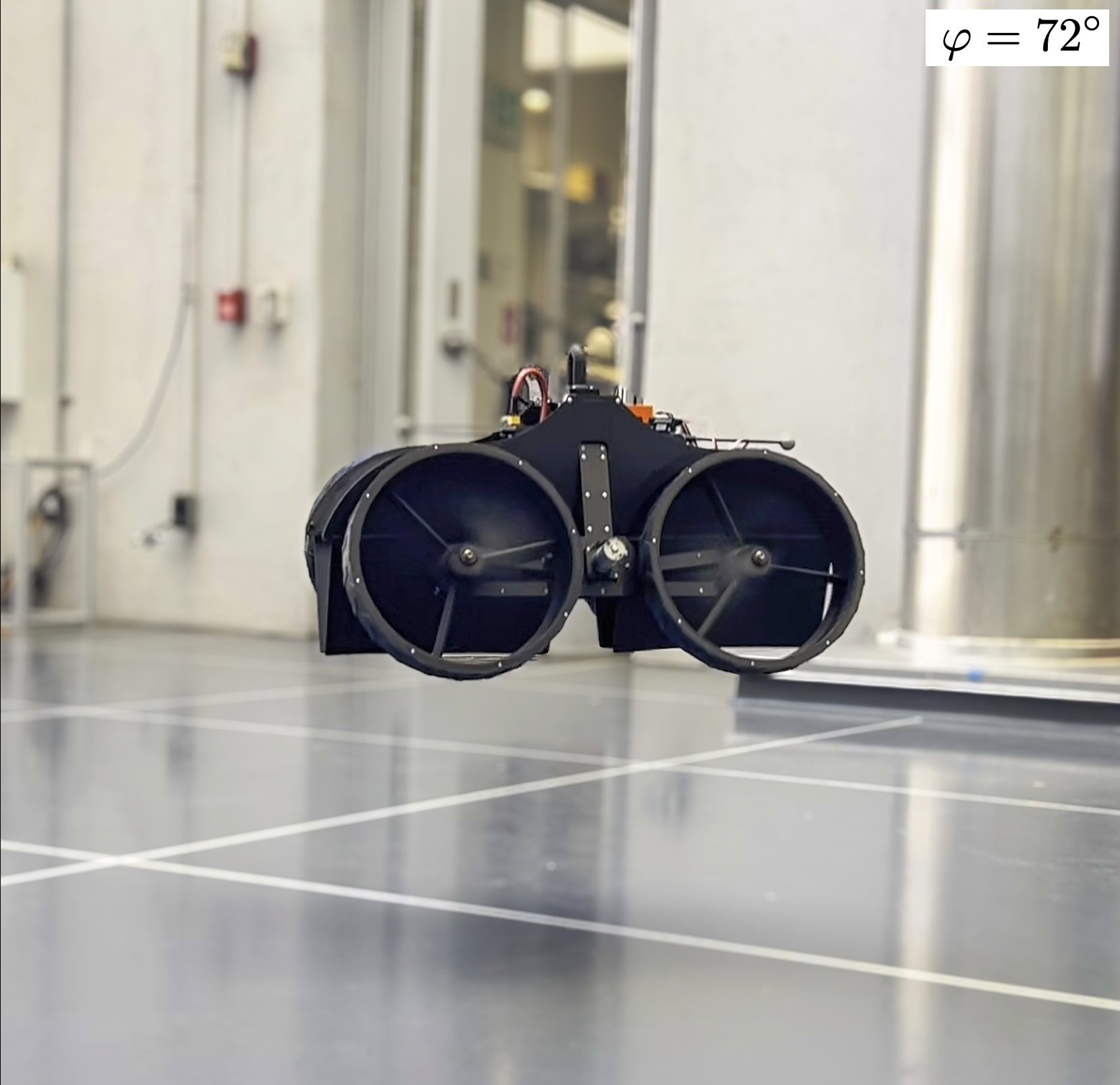
ATMO hovering indoors with its thrusters tilted to 72 degrees
Hovering at φ = 72°. With its thrusters tilted most of the way toward drive mode, ATMO holds a stable hover on thrust that its deflectors redirect downward, and can take off from drive configuration and hop to a new location.
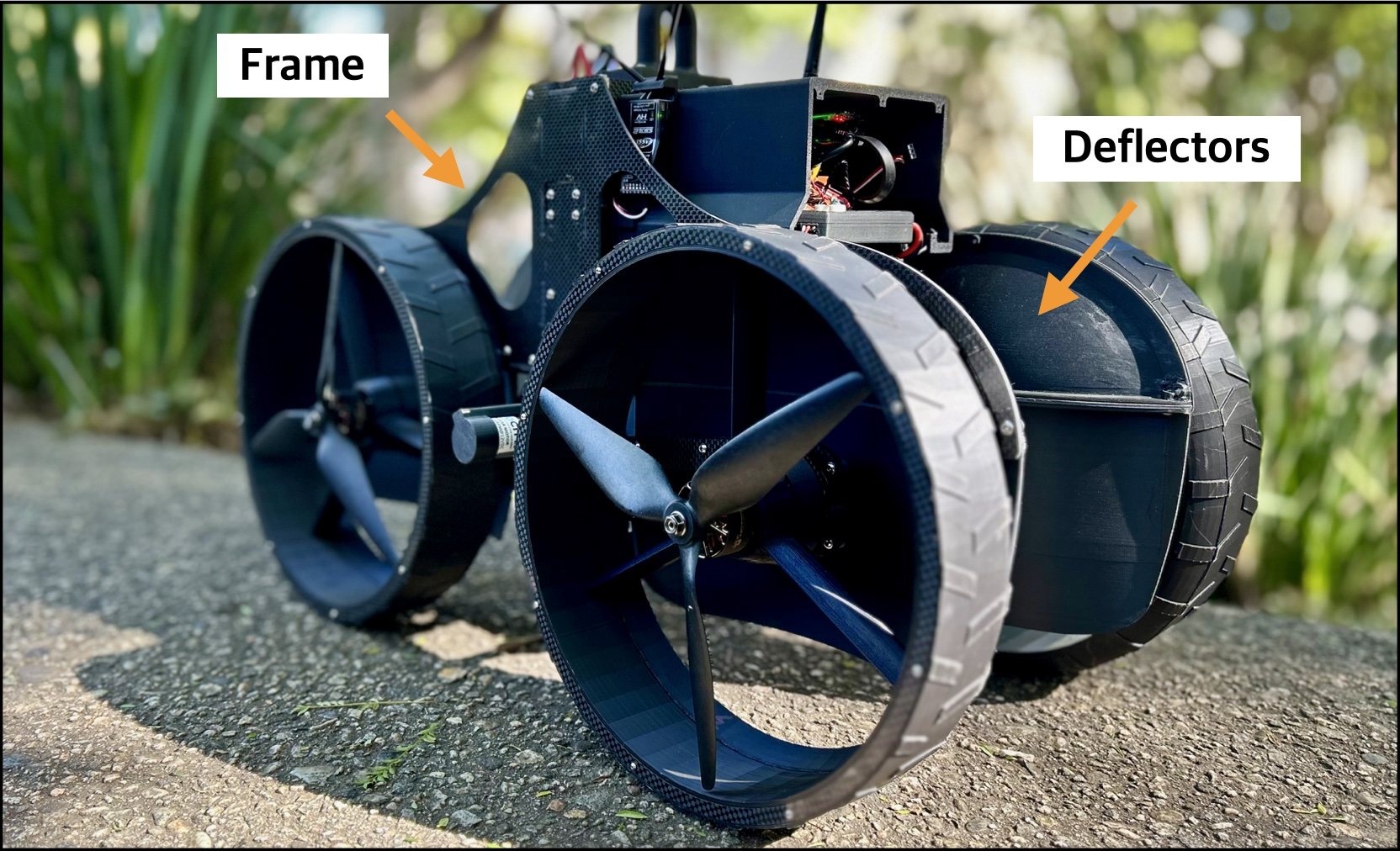
Close-up of ATMO with its carbon frame and internal wake deflectors labelled
Passive by design. Curved deflectors inside the frame sit in the path of the rotor wake. The idea is borrowed from the vectoring nozzles of rockets and jump jets, here realised with no moving parts.

ECC · 2023

Minimum time trajectory generation for bounding flight: combining posture control and thrust vectoring

I. Mandralis, E. Sihite, A. Ramezani, M. Gharib

Birds bound: they tuck their wings mid-flight, changing both their aerodynamics and their inertia at once. We pose that idea as an optimal control problem for an aerial robot with articulated thrusters and solve it by trapezoidal collocation. Coupling posture control with thrust vectoring opens paths through narrow, changing geometries and shortens the time a manoeuvre takes.
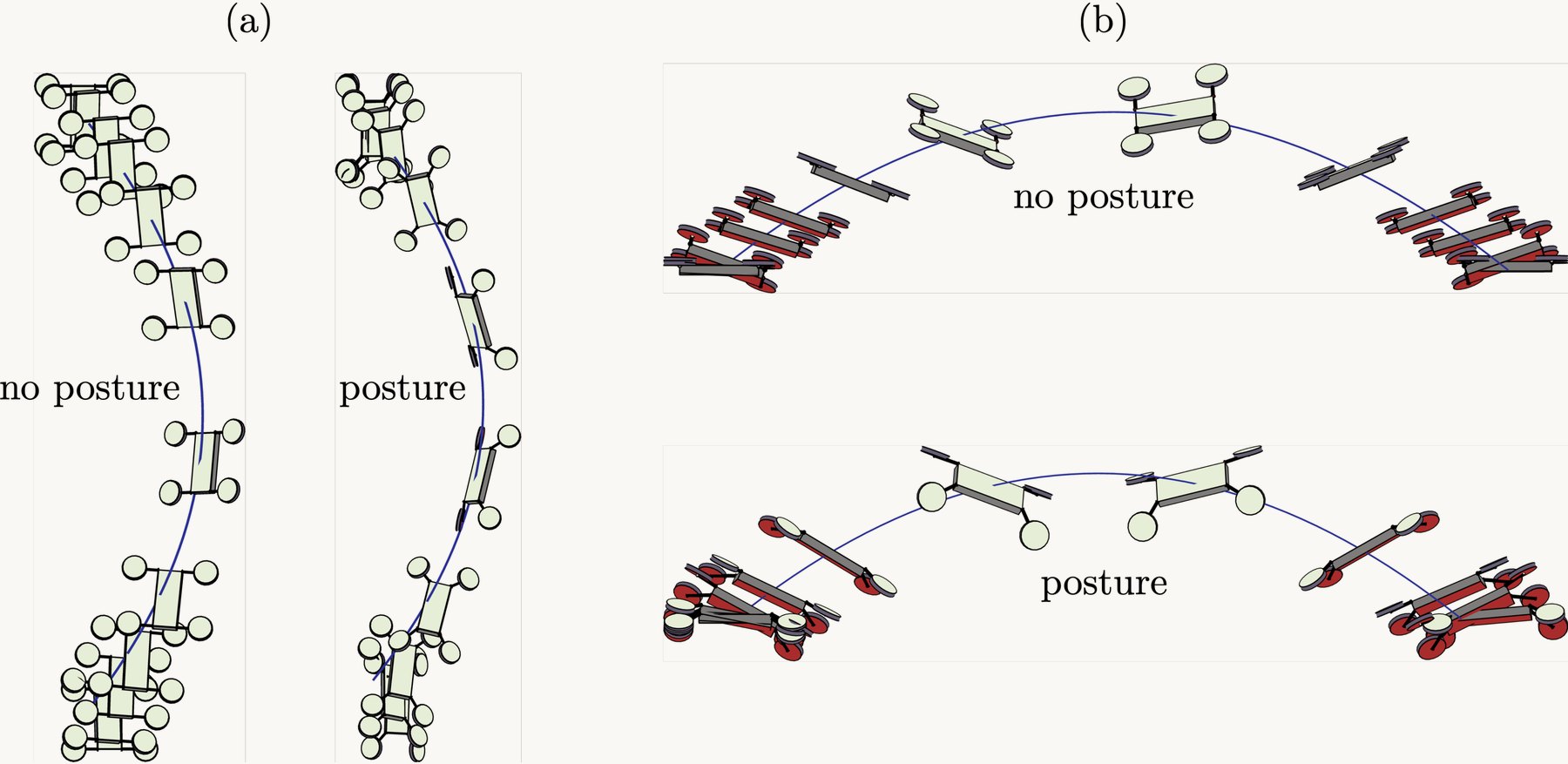
Minimum-time trajectories of a morphing aerial robot with and without posture control, shown as snapshot sequences
Folding the body to fly faster. Snapshots of minimum-time trajectories, with the body shape held fixed and with it controlled. Using posture lets the robot thread passages that are otherwise too tight, and reach the end of the manoeuvre sooner.

Field demonstration, Abu Dhabi · 2024

ATMO in the field: outdoor package delivery with TII

We built a second ATMO for our collaborators at the Technology Innovation Institute in Abu Dhabi and ran it outdoors on a package delivery mission: fly to the drop point, transform close to the ground, land on the wheels and drive the last stretch. The robot was also presented at IROS 2024 in Abu Dhabi, where it was covered by Sky News Arabia.
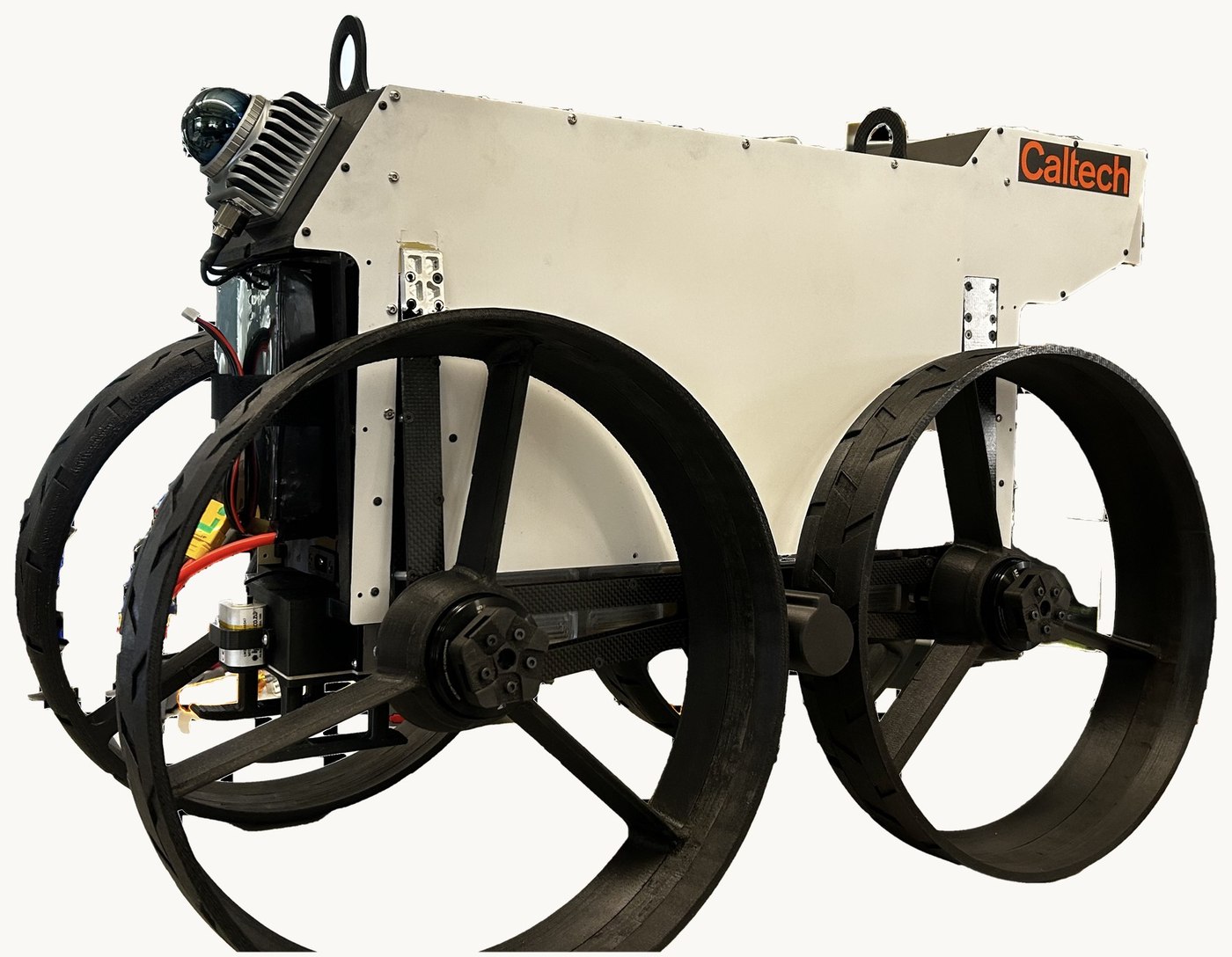
Delivery, end to end. Flight, mid-air transformation, landing on the wheels and the final drive to the doorstep, filmed by the TII media team.
The second ATMO robot: a white chassis on four large wheel-thrusters, marked Caltech
The field build. The ATMO built with TII for outdoor missions, carrying its avionics and battery in the body above four wheel-thrusters that serve as rotors in the air and wheels on the ground.

More research Learning-Based Control · Fluid-Body Interaction and Flow Control · Vision-Based Navigation and Manipulation